The Enchanted Forest Fighter Tree
To protect a forest dove and her nest, the children moved from studying the mechanics of their own bodies to inventing a defensive, jointed tree—discovering how anatomical principles translate into structural engineering.
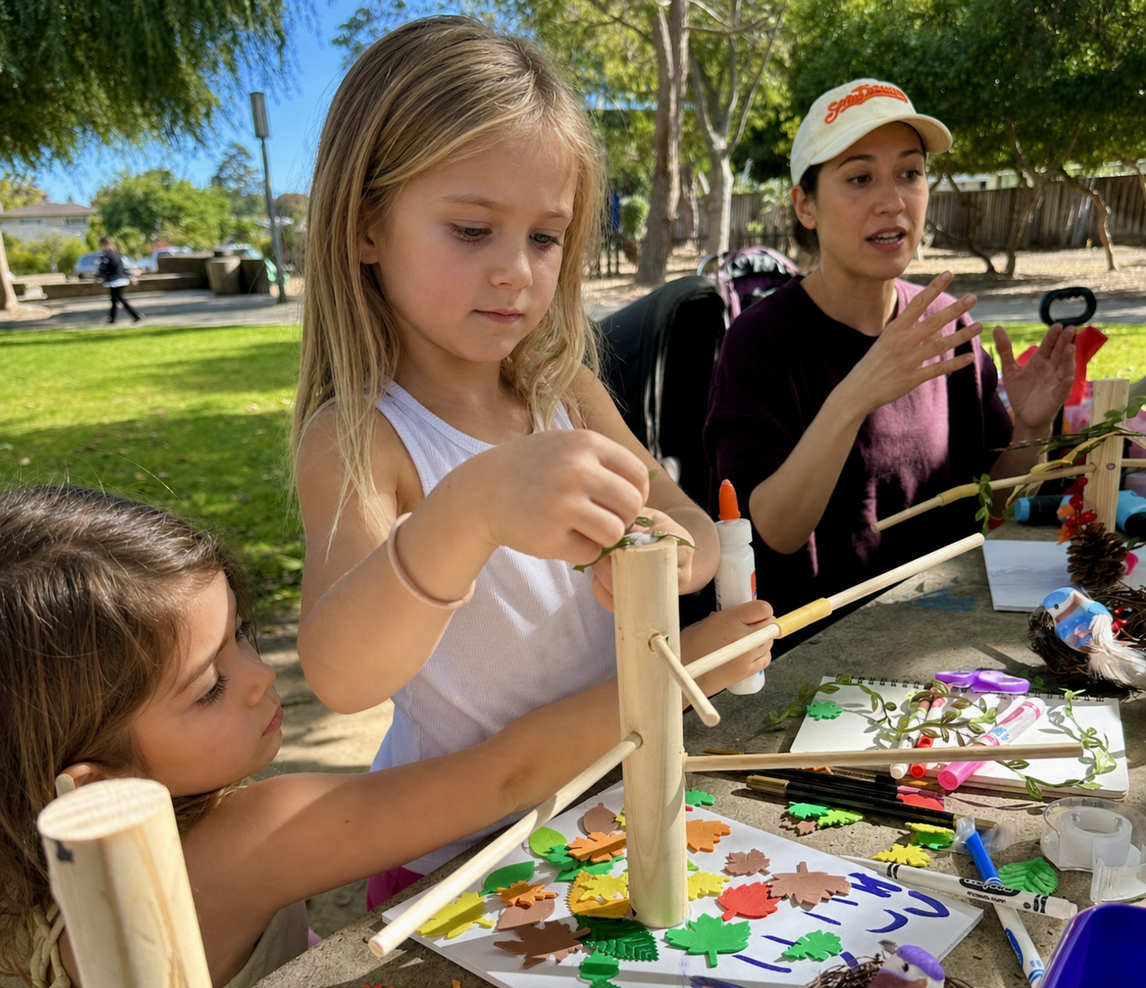
We began our morning at the park, where the children scaled imposing cement dinosaurs and massive boulders—structures that felt delightfully, boundary-pushing-ly high. Instead of reigning them in, we watched them test their physical limits before diving into a wild game of freeze tag. Nora chased Chloe with the raw, focused speed of a cheetah on a savanna, while other kids collided in bursts of laughter. This wasn't just a warm-up; it was a kinesthetic celebration of the very systems we had been studying. We had spent the week exploring our own bodies—running through a giant, parent-built cardiopulmonary map with ping-pong ball 'oxygen molecules,' feeling the contrast of rigid pasta 'bones' wrapped in squishy playdough 'muscles,' and plugging our noses to discover how smell unlocks the taste of a strawberry. But we wanted to move beyond merely observing these living systems. We wanted the children to apply them.
The transition from understanding anatomy to stewarding an ecosystem came when Professor Hootenanny delivered our latest challenge. A delicate forest dove and her nest were under threat from Slogmire, a slippery slug villain. To protect her, the Solution Squad had to invent a new kind of defensive organism: a 'Fighter Tree' featuring flexible, jointed branches. This wasn't a conventional quiz on skeletal anatomy; it was a call to defend an imaginary species using real-world engineering principles borrowed directly from their own joints.
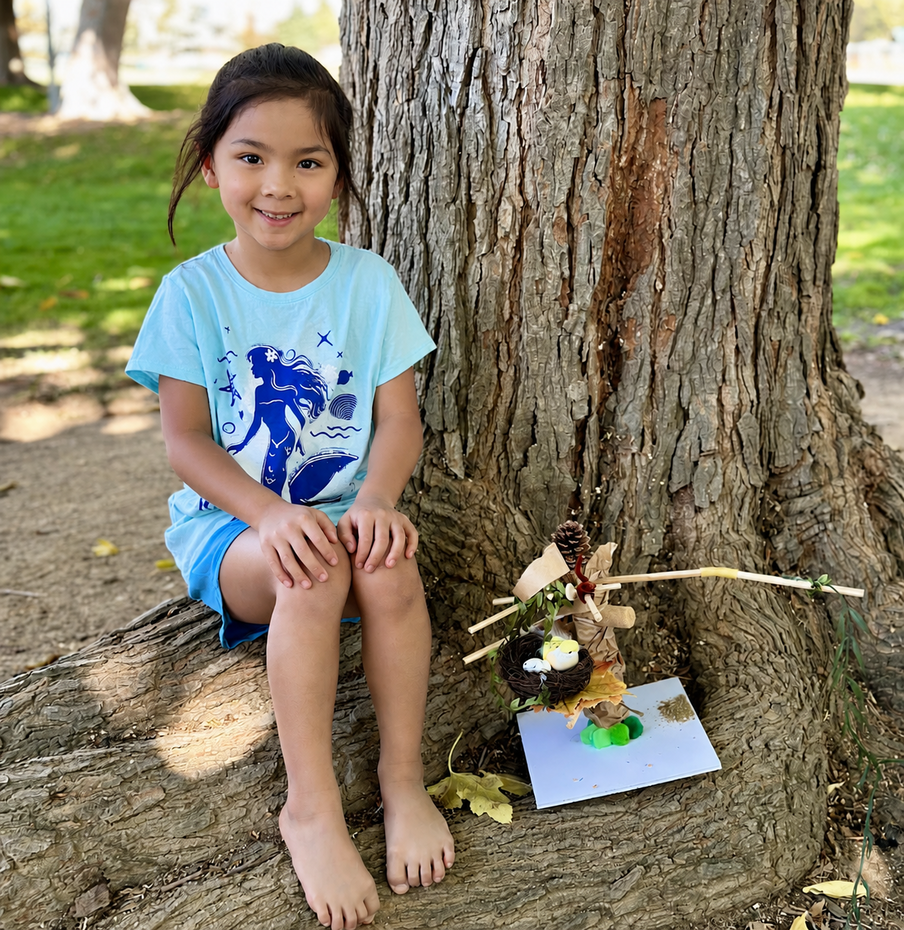
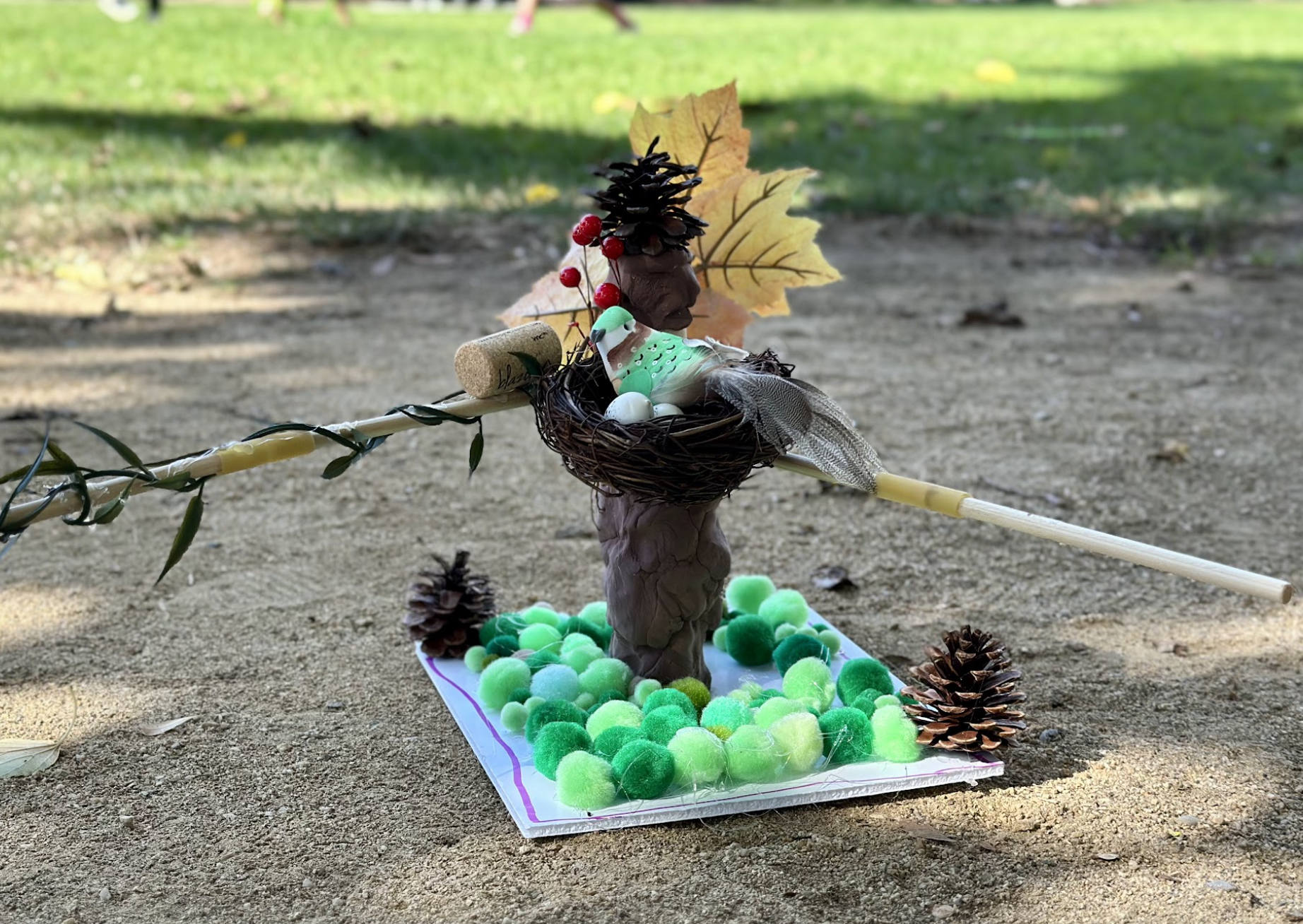
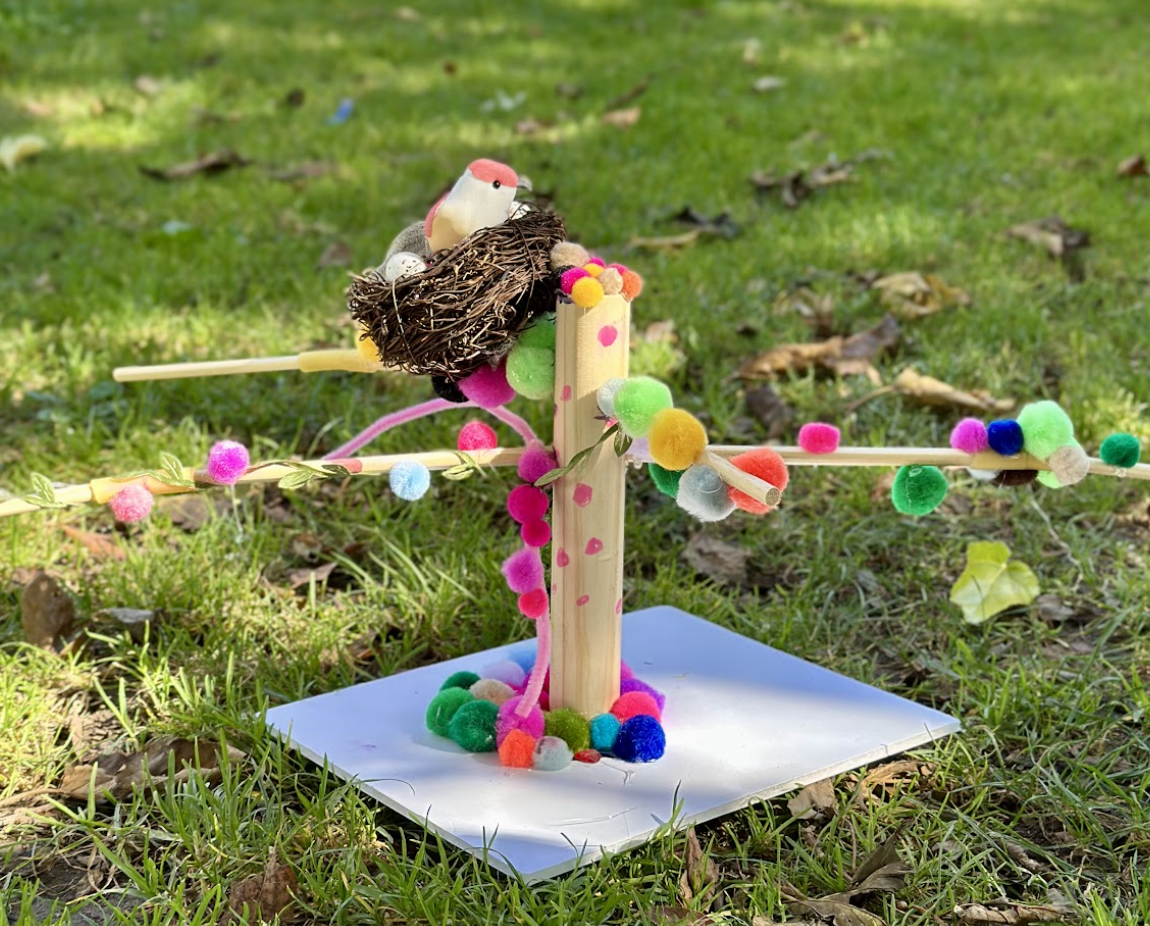
Design thinking always meets the stubborn resistance of real materials. While we assisted by drilling holes into the wooden dowels, the children wrestled with the mechanics of movement. How do you make a branch swing smoothly to swat a slug without losing its structural integrity? They experimented with tension and pivot points, wrapping their wooden structures in crumpled paper bark, hanging long vine-like strings, and planting pom-pom grass at the base. No two trees looked alike. Some branches swung with whip-like speed, while others utilized heavy, sweeping defense mechanisms, but every single child successfully engineered a joint that worked.
Once the defensive trees had successfully fended off Slogmire, the children returned to the wild, carrying their learning into unstructured play. Shoes were kicked off. Sticks became swords and brooms. When a brazen gopher popped its head out of a nearby dirt pile, the kids launched into a spontaneous, joyful game of real-life whack-a-mole, running from hole to hole. Looking up, we spotted Clara perched high in the canopy of a real mulberry tree, completely hidden by a curtain of leaves. She wasn't just hiding; she called down to ask for a blue marker so she could document her thoughts in her mission journal. We had tried to introduce structured independence earlier in the week, a pedagogical experiment that had its share of hiccups and needed to 'cook' a bit longer. But watching Clara in the branches, we realized that real learning doesn't need a tight script. Skip School's role is to create the rich conditions and offer a meaningful challenge—and then trust the children to carry that spark to heights we could never have designed.
We don't need to over-engineer their independence. When we offer a rich challenge and the space to fail, the children naturally carry the learning to heights we could never have scripted.
What this mission grew
This is a normal Tuesday.
Small groups. Real challenges. Kids in the lead. Come see what a week of missions looks like in your area.
Join the Founding Community →